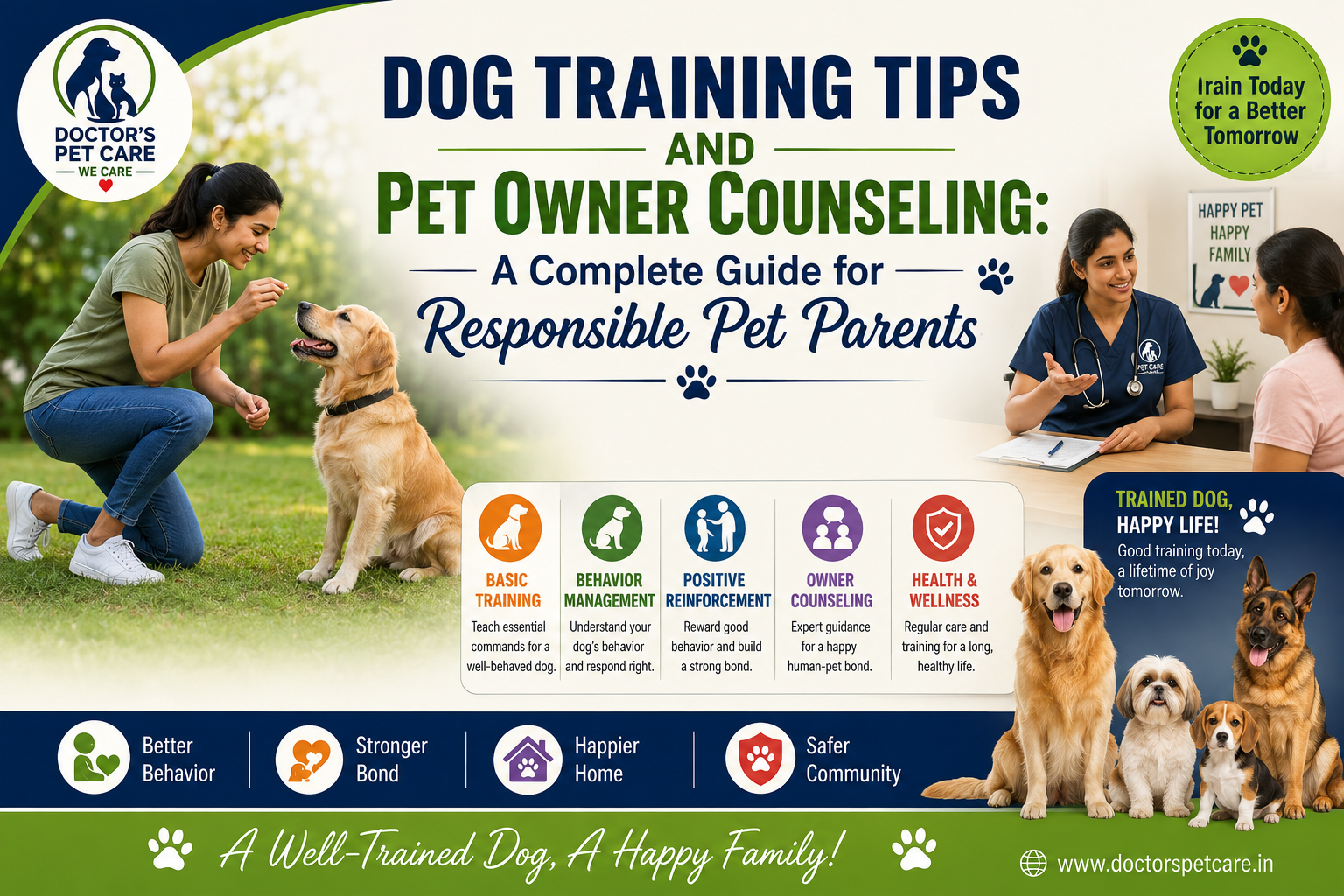
Dog Training Tips and Pet Owner Counseling: A Complete Guide for Responsible Pet Parents
Bringing a dog into your family is a wonderful experience, but responsible pet ownership involves much more than providing food and shelter. Dog training, proper socialization, nutrition, preventive healthcare, regular veterinary checkups, and understanding your pet’s behaviour are all important for raising a healthy and happy dog.
At Doctor’s Pet Care Clinic in Patia, Bhubaneswar, we believe that educating pet owners is an important part of responsible pet care. With the right guidance, patience, and consistent training, pet parents can build a stronger and healthier relationship with their dogs.
Why Is Dog Training Important?
Dog training helps your pet understand what is expected from them and can make everyday life easier for both the dog and the family.
Proper training can help with:
- Basic obedience and commands
- Good behaviour at home
- Leash walking
- Toilet training
- Puppy socialization
- Reducing unwanted behaviours
- Better interaction with family members
- Building trust between pets and owners
Training should be based on patience, consistency, positive reinforcement, and appropriate veterinary guidance when behaviour changes may be related to health problems.
1. Start Training Your Puppy Early
Puppies are naturally curious and learn from their surroundings. Early training can help them develop good habits.
Begin with simple commands such as:
- Sit
- Stay
- Come
- Down
- Leave it
- No
Keep training sessions short and positive. Puppies can become distracted or tired quickly, so several short sessions can be more effective than one long session.
2. Use Positive Reinforcement
Reward-based training can encourage your dog to repeat desirable behaviours.
When your dog responds correctly, you can use:
- Praise
- Gentle affection
- Appropriate treats
- A favourite toy
Avoid frightening or physically punishing your dog. The goal of training should be to help your pet understand what you expect while building trust and confidence.
3. Be Consistent With Training
Consistency is one of the most important parts of dog training.
If one family member allows a behaviour while another family member discourages it, your dog may become confused.
For example, if you do not want your dog on the sofa, everyone in the household should follow the same rule.
Use the same commands and reward good behaviour consistently.
4. Focus on Socialization
Socialization helps dogs become more comfortable with different people, environments, sounds, and situations.
Depending on your dog’s age, health, vaccination status, and temperament, appropriate socialization may include gradually introducing your pet to:
- Different people
- Safe environments
- Household sounds
- Other suitable dogs
- Car travel
- Veterinary clinic visits
- New experiences
Puppy socialization should be approached carefully and in accordance with your veterinarian’s vaccination and health recommendations.
5. Teach Your Dog Proper Leash Behaviour
Walking your dog is important for exercise, mental stimulation, and bonding.
Start by allowing your dog to become comfortable with the collar or harness and leash. Encourage calm walking and reward your dog when they stay near you.
If your dog constantly pulls, lunges, or shows fear or aggression while walking, seek professional behavioural advice rather than forcing the dog into stressful situations.
6. Establish a Toilet Training Routine
Toilet training requires patience and a predictable routine.
Take your puppy outside or to the designated toilet area at appropriate times, such as after:
- Waking up
- Eating
- Drinking
- Playing
- Sleeping
Praise your puppy when they eliminate in the correct place.
Accidents are common during puppyhood. Avoid punishment and focus on establishing a consistent routine.
7. Understand Changes in Your Dog’s Behaviour
Sometimes unwanted behaviour may not simply be a training problem.
Changes such as sudden aggression, excessive barking, hiding, unusual restlessness, loss of appetite, excessive licking, or changes in toilet habits can sometimes be associated with pain, illness, anxiety, or other underlying problems.
If your dog’s behaviour changes suddenly or significantly, consult a veterinarian.
A veterinary examination can help determine whether there may be a health-related reason for the behaviour.
8. Nutrition Is Part of Good Pet Care
Training and nutrition go hand in hand.
Dogs need a diet appropriate for their:
- Age
- Breed or size
- Activity level
- Growth stage
- Health requirements
Treats can be useful during training, but excessive treats can contribute to unhealthy weight gain.
If you are unsure about your dog’s diet, speak with a veterinarian for appropriate pet nutrition guidance.
9. Regular Veterinary Checkups Matter
Training cannot replace veterinary healthcare.
Regular veterinary checkups can help monitor your dog’s overall health and provide guidance about:
- Vaccinations
- Parasite prevention
- Nutrition
- Growth and development
- Dental health
- Weight management
- Preventive healthcare
Puppies and senior dogs may require particular attention because their healthcare needs can change throughout different stages of life.
10. Help Your Dog Become Comfortable With Veterinary Visits
Many dogs become nervous when visiting a veterinary clinic.
Pet owners can make visits easier by creating positive experiences around handling and travel.
At home, gradually allow your dog to become comfortable with gentle handling of the:
- Ears
- Paws
- Mouth
- Coat
- Tail
Never force handling if your dog is frightened or aggressive. Your veterinarian can guide you on safe approaches.
At Doctor’s Pet Care Clinic, our approach focuses on gentle and attentive veterinary care to help pets and their families feel comfortable.
Pet Owner Counseling: What Every Dog Parent Should Know
Responsible pet ownership is a long-term commitment. Pet parents should understand their dog’s individual needs instead of following generic advice.
Important areas of pet owner counseling include:
🐾 Behaviour and Training
Understand your dog’s normal behaviour and learn how to encourage positive habits.
🥗 Nutrition
Provide age-appropriate and nutritionally suitable food and avoid unnecessary treats or unsuitable human foods.
💉 Vaccination
Follow your veterinarian’s recommendations for vaccinations and preventive healthcare.
🩺 Health Monitoring
Watch for changes in appetite, weight, energy, skin, coat, urination, stool, and behaviour.
🧼 Hygiene and Grooming
Regular grooming and hygiene can support skin, coat, ear, nail, and overall cleanliness.
❤️ Exercise and Mental Stimulation
Dogs need appropriate physical activity and mental stimulation according to their age, breed, health, and individual needs.
When Should You Consult a Veterinarian?
Contact your veterinarian if your dog develops symptoms such as:
- Sudden behaviour changes
- Persistent vomiting or diarrhea
- Loss of appetite
- Unusual tiredness
- Excessive thirst or urination
- Persistent itching
- Difficulty walking
- Pain or discomfort
- Unexplained weight loss
- Aggression or anxiety that appears suddenly
Behavioural problems should not always be treated as simple training issues. A veterinary assessment may be appropriate when a health problem could be contributing to the behaviour.
Dog Care and Veterinary Guidance at Doctor’s Pet Care Clinic
Doctor’s Pet Care Clinic provides compassionate veterinary care for pet families in Patia, Kanan Vihar, Chandrasekharpur and nearby areas of Bhubaneswar.
Our services include pet health checkups, vaccination guidance, preventive pet care, puppy and kitten care, and pet nutrition and veterinary consultation.
If you are a new pet parent or have questions about your dog’s health, behaviour, nutrition, or general care, consulting a veterinarian can help you make informed decisions for your pet.
Give Your Dog the Care They Deserve
A healthy and well-adjusted dog starts with responsible pet ownership.
Train with patience. Feed with care. Monitor their health. Visit your veterinarian regularly.
For veterinary consultation and pet care guidance:
Doctor’s Pet Care Clinic
📍 Near Swastik Villa, Kanan Vihar, Patia, Bhubaneswar, Odisha – 751031
📞 9437075882/8249390160
🌐 www.doctorspetcare.in
Doctor’s Pet Care Clinic — Compassion • Care • Commitment